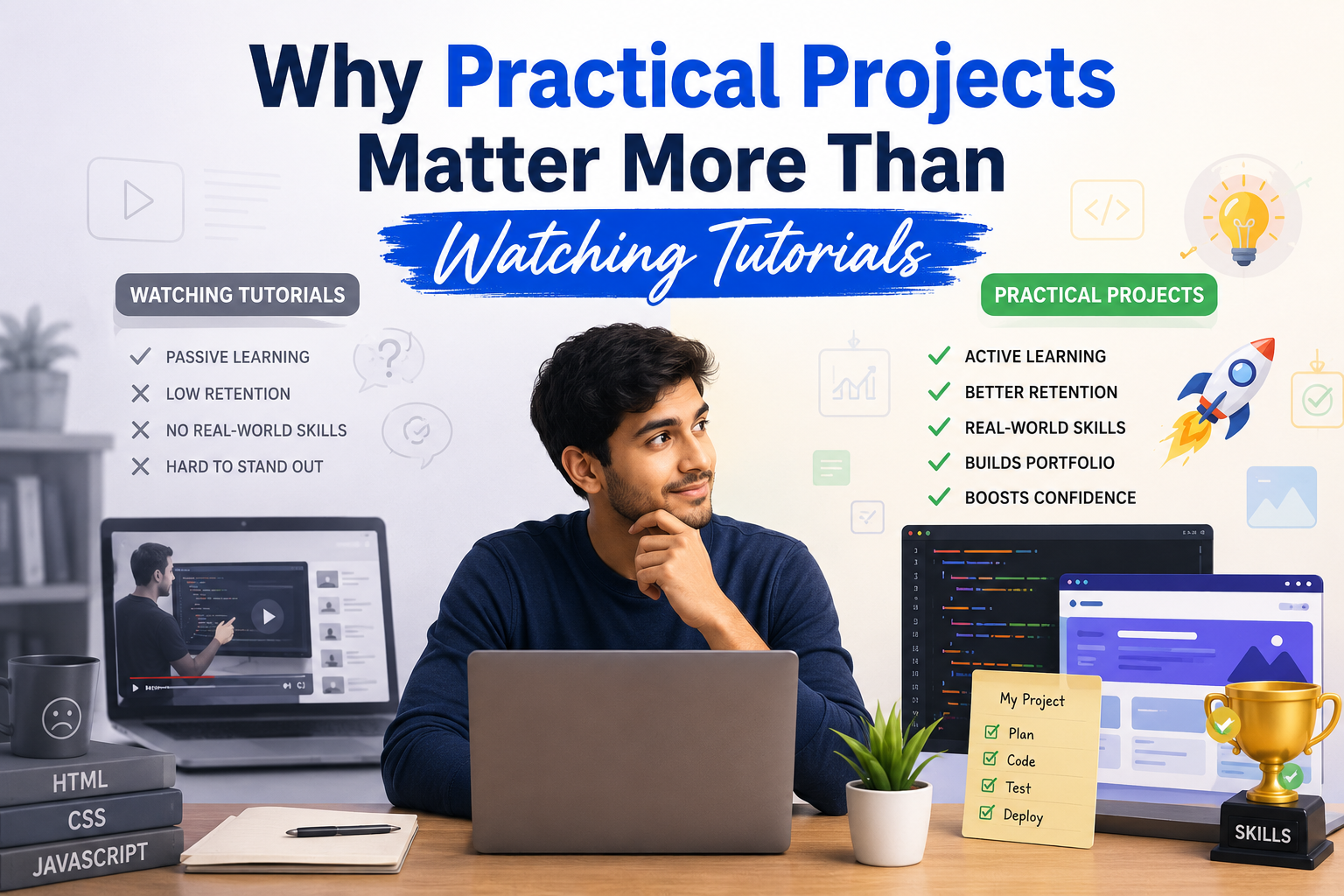
Have you ever learned to ride a bicycle by watching someone else pedal?
So why are so many aspiring video editors trying to master editing by falling into the tutorial rabbit hole?
Every day, thousands of creators spend hours consuming YouTube videos about transitions, color grading, motion graphics, and cinematic editing. They feel productive because they’re learning something new.
But when it finally comes time to edit a real project, they freeze. The timeline looks unfamiliar. The shortcuts disappear from memory. The creativity they admired in tutorials suddenly feels impossible to recreate. Breaking down the truth that every successful editor eventually discovers:
Watching tutorials teaches concepts. But practical projects build skills. And in today’s creator economy, you get hired by proven skills, not just theoretical knowledge.
The Tutorial Trap
Watching tutorials is valuable; they introduce you to new tools, workflows, and creative techniques. But the problem starts when tutorials become your habit and the only source of learning.
And in today’s world many beginners fall into a cycle like this:
- They watch a tutorial on cinematic transitions.
- Save another video on color grading.
- Bookmark motion graphics lessons.
- Watch “Top 50 Premiere Pro Tips.”
- And this repeats.
Weeks pass by watching 100 videos. Yet you can do zero real edits. You know why?
Because the method you follow is called passive learning, your brain recognizes information, but it hasn’t practiced applying it.
Research in educational psychology consistently shows that active practice and retrieval lead to stronger long-term retention than passive observation. In other words, doing the work helps you remember and improve far more effectively than simply watching someone else do it.
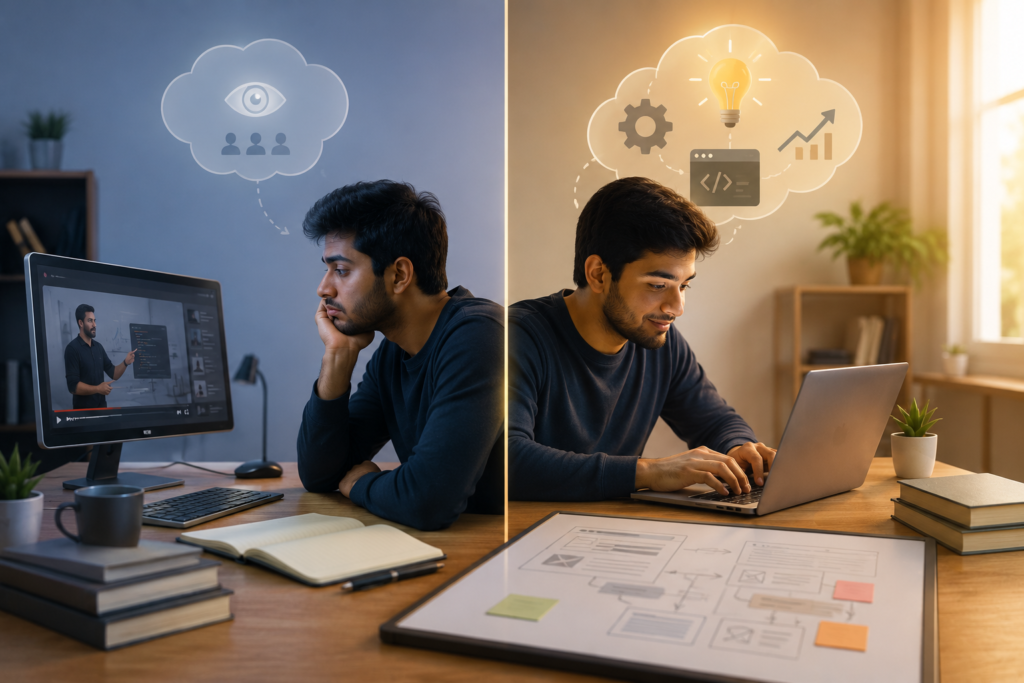
Real Editing Happens Through Solving Problems
Professional editors don’t work with perfectly prepared for revisions; they deal with poor lighting, shaky camera movements, missing audio, tight deadlines, client revisions, and different aspect ratios for multiple platforms.
And there isn’t any tutorial that can fully prepare you for these situations. Only real projects can do it. Every project forces you to think critically:
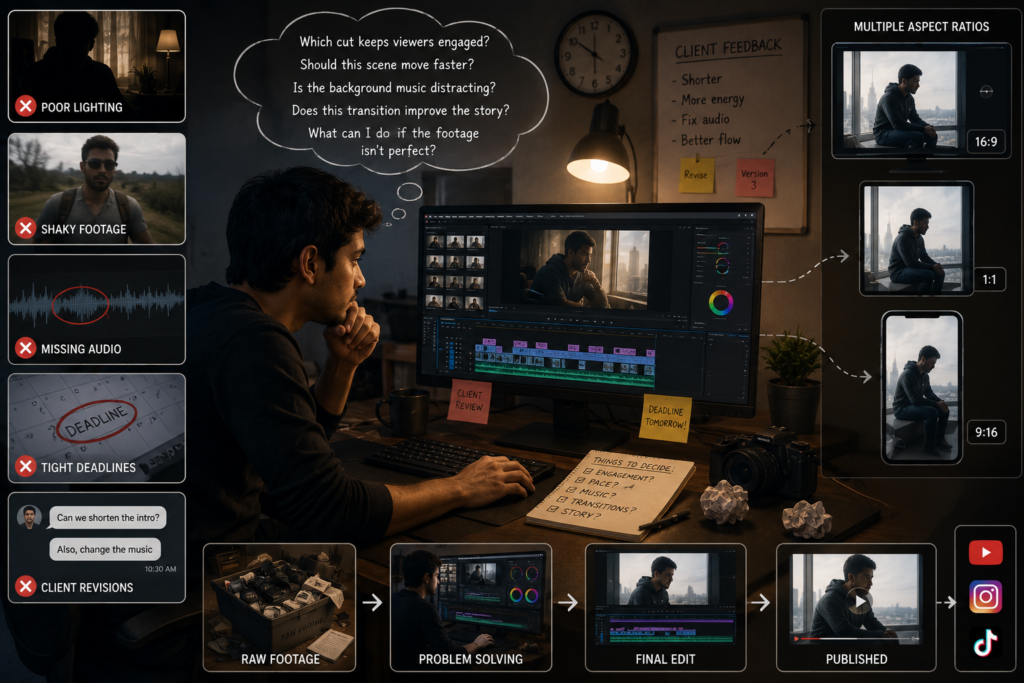
- Which cut keeps viewers engaged?
- Should this scene move faster?
- Is the background music distracting?
- Does this transition improve the story?
- What can I do if the footage isn’t perfect?
These decisions develop creative judgment, something tutorials alone can’t teach.
Muscle Memory Is Built on the Timeline
Have you ever watched someone play the piano? It looks effortless. But that confidence comes from thousands of hours of practice and not from reading sheet music. Therefore, video editing works the same way. The more projects you complete, the faster your hands begin to remember:
- The keyboard shortcuts
- The timeline navigation
- Audio adjustments
- Colour correction workflows
- Export settings
- Efficient editing techniques
Eventually, editing becomes second nature. That’s when creativity starts replacing confusion. Every project you complete becomes a part of your portfolio. Here’s something many beginners overlook:
Employers and clients rarely ask, “How many tutorials have you watched?” Instead, what they ask is, “Can I see your work?”
Hence, your portfolio becomes your proof. Because every completed project demonstrates your editing style, your storytelling ability, your technical skills, the consistency you have, and the attention to detail.
Even a simple edit can show growth. A collection of real projects carries far more value than a playlist full of completed tutorials.
Mistakes Are Your Best Teachers
Nobody enjoys making mistakes. But every experienced editor will tell you that mistakes accelerate learning. Maybe you accidentally deleted an important sequence. Perhaps your export settings reduced video quality. Or your audio wasn’t synchronized properly.
These moments can be frustrating, but they’re also memorable. You rarely repeat the same mistake twice because you’ve experienced the consequences firsthand.
That’s exactly how practical learning works. Every challenge improves your workflow. Every mistake makes you a better editor. Rather,
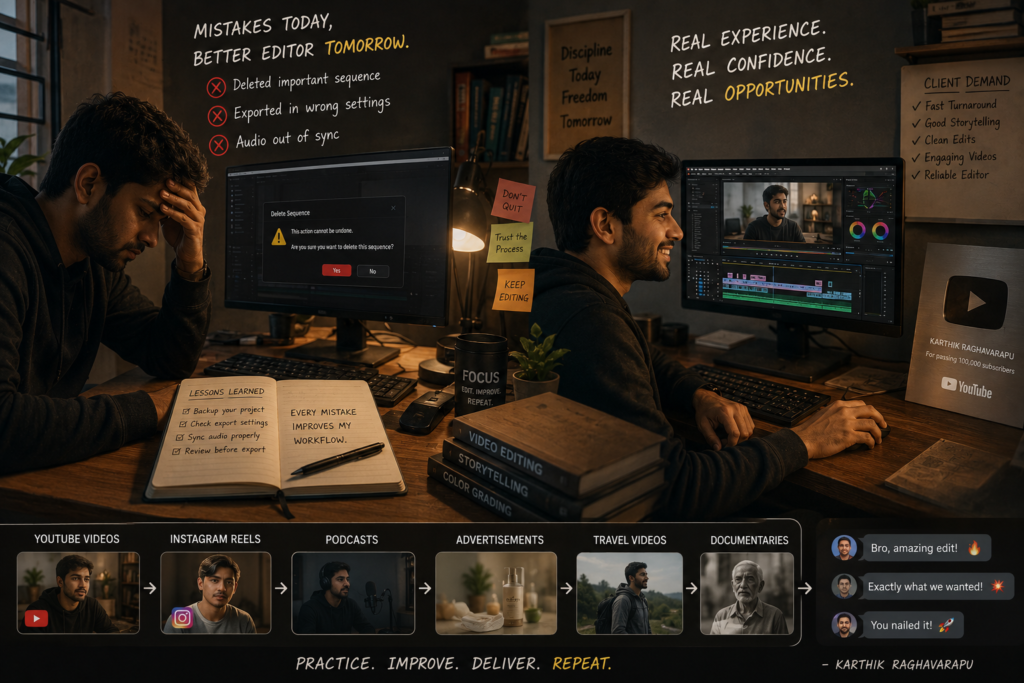
The content creation industry is evolving faster than ever. Businesses, influencers, YouTubers, filmmakers, startups, and brands all need skilled video editors. And what they need isn’t someone who knows every editing feature. Rather, they need someone who can confidently deliver a finished video.
That’s why practical experience gives you a competitive advantage. When you’ve edited YouTube videos, Instagram Reels, podcasts, advertisements, travel videos, or documentaries, you gain confidence that can’t be taught in theory alone.
Confidence comes from doing.
How to Learn Faster Through Projects
If you’re serious about becoming a video editor, shift your focus. Instead of spending five hours watching tutorials, give your time to learning a concept. Then spend four hours applying it.
Challenge yourself with projects like:
- Edit a 30-second Instagram Reel.
- Create a YouTube intro.
- Produce a travel montage.
- Design a product advertisement.
- Edit a short interview.
- Build a cinematic sequence using raw footage.
Every completed project teaches dozens of lessons that no tutorial can replicate. Progress doesn’t come from collecting knowledge. It comes from creating.
Final Thoughts
Tutorials are the map, and projects are the journey. If your goal is to become a confident, job-ready video editor, don’t measure your progress by the number of videos you’ve watched.
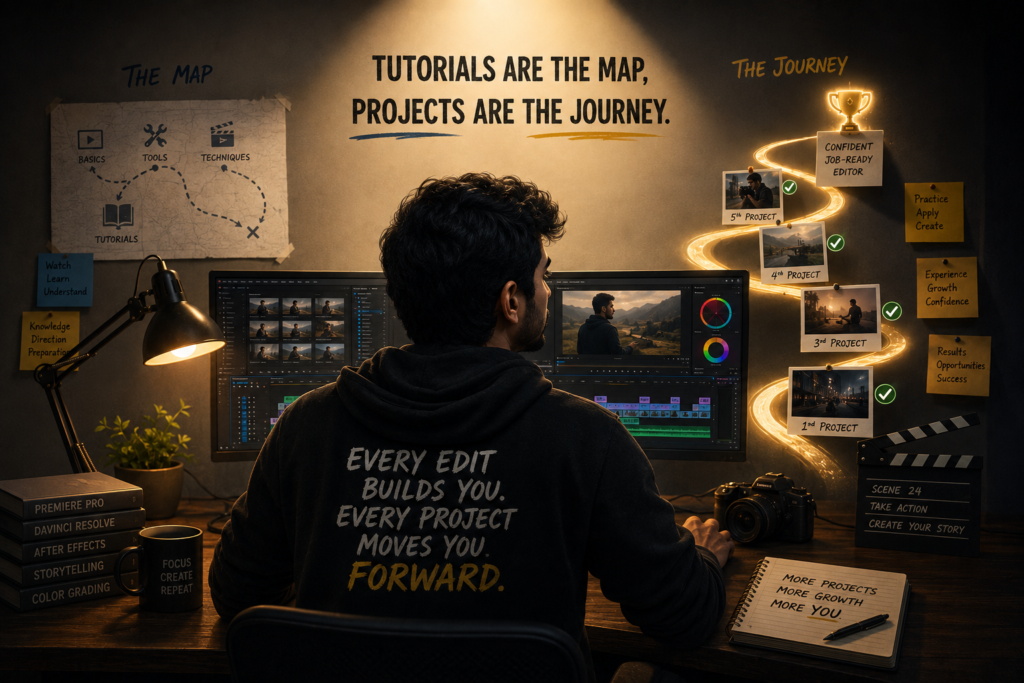
Measure it by the number of projects you’ve completed. Because every timeline you build strengthens your creativity. Every edit sharpens your instincts. Every finished video moves you one step closer to becoming the editor clients want to hire.
Ready to Stop Watching and Start Creating?
At Plan At B, we believe the fastest way to become a skilled video editor is by working on real-world projects, not just consuming endless tutorials. Our hands-on training is designed to help you build confidence, create a professional portfolio, and develop the practical skills that employers and clients value.
Don’t just learn editing; practice it, master it, and turn it into a career.
Join Plan At B today and start building projects that open doors to freelance opportunities, creator collaborations, and full-time editing careers. Your first great edit starts with your first real project.