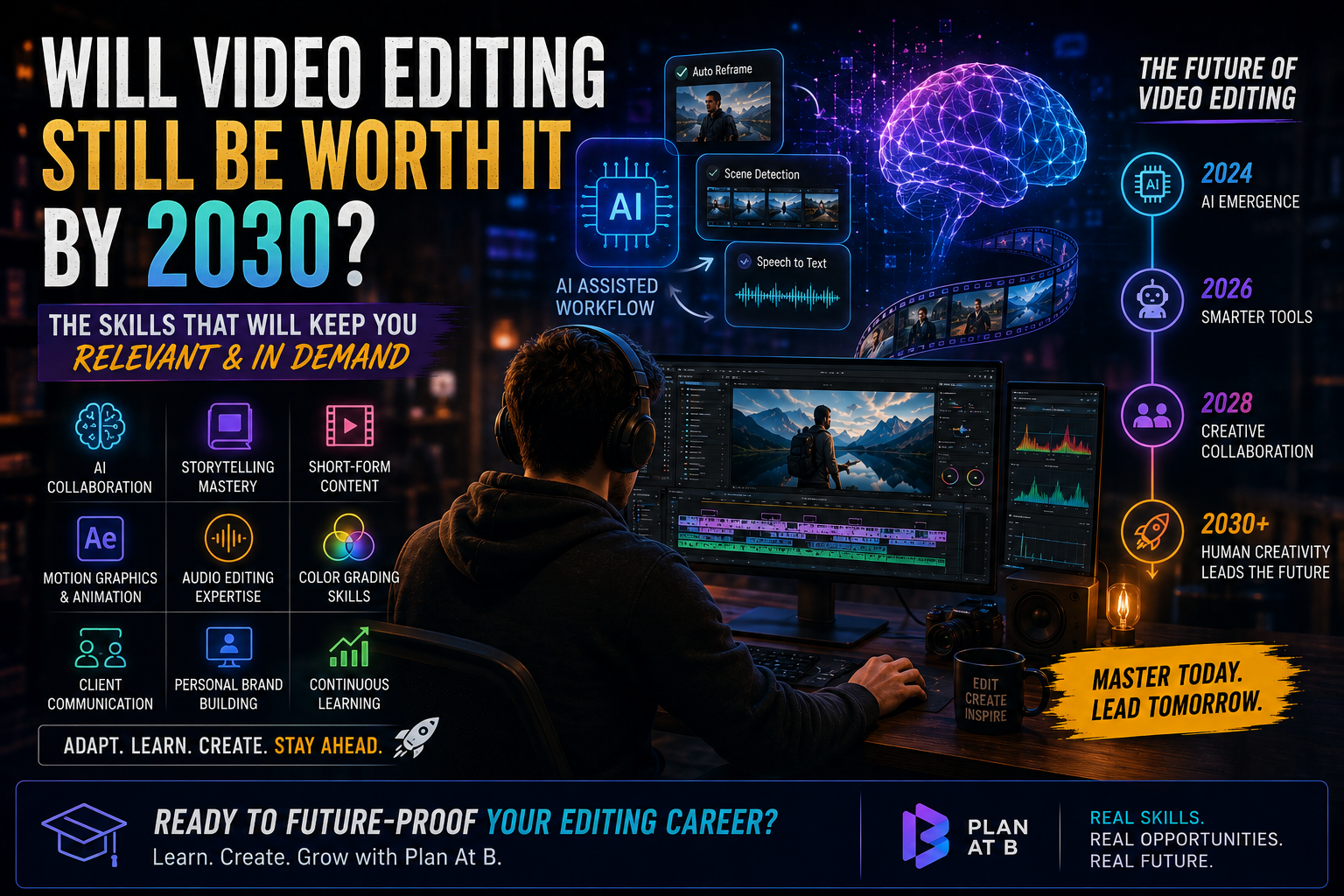
The video editing industry is changing faster than ever before. Five years ago, simply knowing Adobe Premiere Pro or Final Cut Pro was enough to land freelance projects or even a full-time editing job. Today, artificial intelligence can remove silences, generate subtitles, create rough cuts, and even suggest transitions within minutes. Naturally, many aspiring editors are asking the same question: Will video editing still be a valuable career by 2030?
The answer is yes—but only for editors who continuously evolve their skills. Technology is changing the way videos are edited, but it is not replacing creativity, storytelling, and strategic thinking. Instead, it is raising the standard of what clients expect.
If you’re planning to build a long-term career in video editing, here are the skills that will keep you relevant well beyond 2030.
AI Collaboration Will Be More Important Than AI Competition
Artificial intelligence is already transforming post-production. Tools like Adobe Firefly, Premiere Pro’s AI-powered features, Runway, and Descript can automate repetitive editing tasks such as background removal, speech enhancement, transcript editing, and object selection.
But here’s the reality: AI creates speed—not vision.
Businesses, brands, filmmakers, and content creators still need someone who understands pacing, emotion, audience behavior, and storytelling. Editors who know how to combine AI tools with creative judgment will deliver projects faster without sacrificing quality.
Instead of fearing AI, learn how to use it as your creative assistant.
Storytelling Will Always Be the Ultimate Skill
No software can replace human emotion.
A technically perfect edit can still fail if it doesn’t connect with the audience. The best editors understand how to guide viewers through a story using rhythm, music, timing, and visual flow.
Whether you’re editing:
- YouTube documentaries
- Podcasts
- Brand advertisements
- Wedding films
- Instagram Reels
- Feature-length films
…the editor’s biggest responsibility is making people feel something.
Strong storytelling will remain one of the most valuable skills throughout this decade.
Short-Form Content Expertise Will Stay in High Demand
The rise of TikTok, Instagram Reels, YouTube Shorts, and LinkedIn video has permanently changed how businesses communicate online.
Brands are no longer looking for editors who can only create long-form videos. They need professionals who understand:
- Viewer retention
- Fast-paced editing
- Hook creation
- Vertical video optimization
- Platform-specific trends
By 2030, short-form content will continue to dominate digital marketing, making these skills highly valuable for freelancers and agencies alike.
Motion Graphics and Animation Will Set You Apart
Basic editing is becoming easier thanks to automation.
Motion graphics, however, still require creativity and technical expertise.
Learning Adobe After Effects or similar motion design tools allows you to create:
- Animated titles
- Logo reveals
- Infographics
- Social media animations
- Product explainers
- Visual effects
Editors who combine traditional editing with motion graphics consistently earn higher-paying projects because they offer clients more value in a single package.
Audio Editing Will Become a Competitive Advantage
Many beginners focus only on visuals while ignoring sound.
Professional editors know that poor audio immediately lowers the quality of any video. Clean dialogue, balanced background music, sound effects, and proper mixing significantly improve the viewer’s experience.
Learning noise reduction, audio cleanup, equalization, and sound design will make your edits feel polished and professional.
Color Correction and Color Grading Will Continue to Matter
AI can make automatic color adjustments, but it cannot always understand the creative mood a project requires.
Color grading influences how viewers emotionally experience a video.
Whether you’re creating cinematic films, commercials, travel content, or corporate videos, understanding color theory and grading techniques will remain an important professional skill.
Editors who master color consistently produce work that looks more premium than automated edits.
Client Communication Is Becoming Just as Important as Editing
By 2030, clients won’t simply hire editors—they’ll hire creative partners.
Successful editors know how to:
- Understand project goals
- Meet deadlines
- Accept feedback professionally
- Present creative ideas
- Manage revisions efficiently
Excellent communication builds long-term client relationships, repeat business, and referrals.
Many highly paid editors earn more because they solve business problems—not just editing tasks.
Building a Personal Brand Will Create More Opportunities
The best editors today don’t rely solely on freelance platforms.
They build visibility through:
- YouTube
- Behance
- Personal portfolios
Sharing editing tips, before-and-after transformations, breakdown videos, and client success stories helps establish credibility.
By 2030, employers and clients will increasingly choose editors whose skills are already visible online.
Continuous Learning Is the Real Career Insurance
Editing software will continue evolving. New formats, AI tools, cameras, and content styles will emerge every year.
The editors who thrive won’t necessarily be the most experienced—they’ll be the ones who never stop learning.
Invest time in mastering new software, following industry trends, practicing different editing styles, and building real-world projects. Adaptability will always outperform complacency.
Final Thoughts
The future of video editing isn’t about competing with artificial intelligence—it’s about becoming the kind of creative professional that technology cannot replace.
Editors who combine storytelling, technical expertise, AI knowledge, motion graphics, sound design, and strong communication skills will remain in demand across industries. While software will continue to evolve, creativity, strategy, and human insight will always be the foundation of great editing.
The opportunities are there for those willing to learn, adapt, and grow.
Ready to Future-Proof Your Editing Career?
At Plan At B, we don’t just teach you how to use editing software—we help you build the creative, technical, and professional skills needed to succeed in the real world. From industry-standard tools and AI-assisted workflows to storytelling techniques and portfolio-building, our training prepares you for the future of video editing.
Start learning today and build the skills that will keep you in demand until 2030 and beyond. Join Plan At B and turn your passion for editing into a future-ready career.